Human Design types describe how your energy works and how you make decisions. Your Human Design type is the first thing your chart shows and shapes how you move through daily life.
Type, strategy and authority from your date, time and place of birth. Free bodygraph, instantly.
Get my Human Design →What is Human Design?
Human Design is a system that uses your birth date, time and place to calculate a chart called the bodygraph. The chart shows how your energy moves, how you meet other people and how you can experiment with decisions.
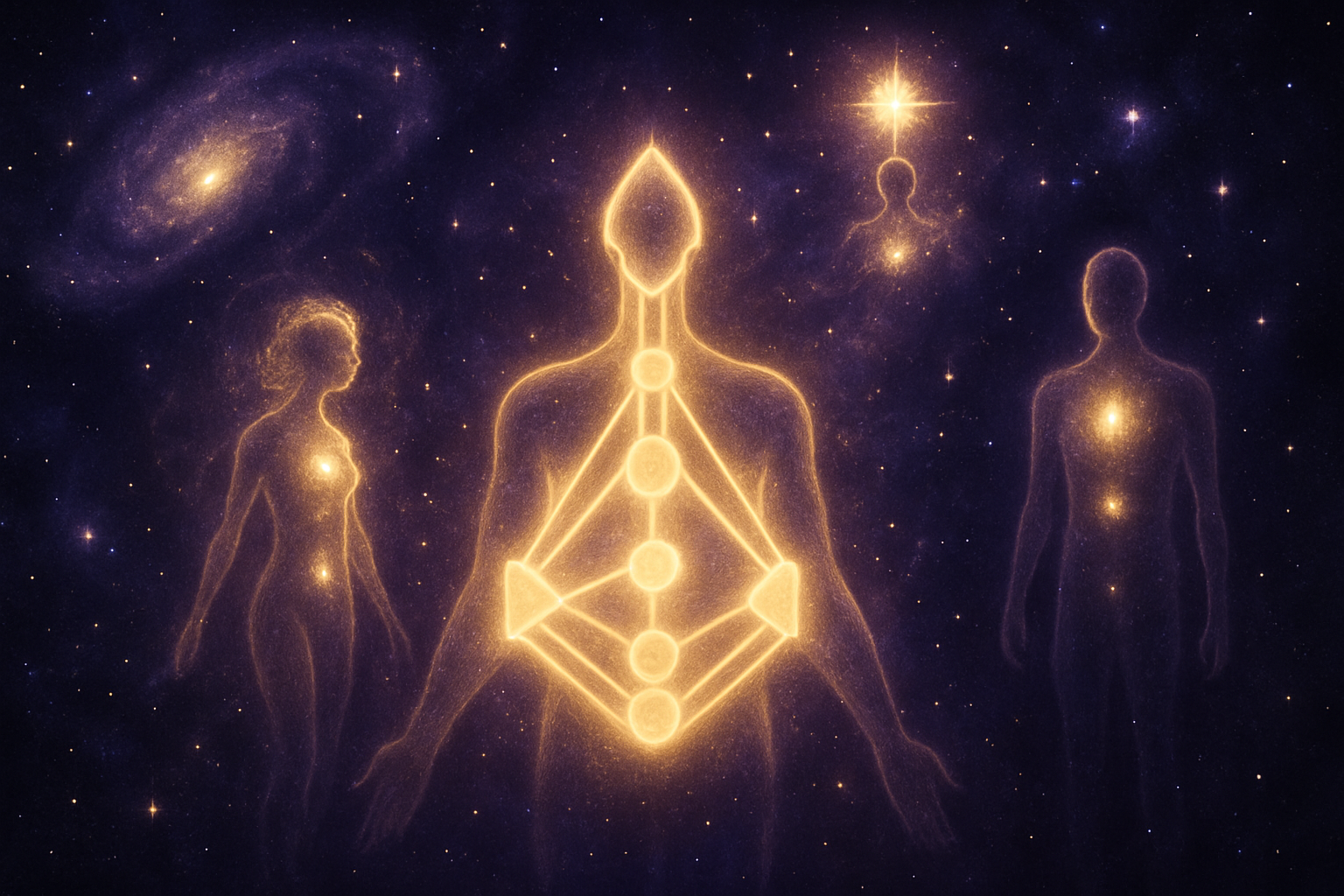
The bodygraph has 9 centers: Head, Ajna, Throat, G Center, Heart (Ego), Solar Plexus, Sacral, Spleen and Root. Some centers are colored in (defined) and some are white (open). A defined center works in a consistent way and tends to set the tone for others around you.
An open center takes in and amplifies the energy around you and is a place of learning, not a flaw. Four of the centers are motors: Sacral, Root, Solar Plexus and Heart (Ego). In Human Design tradition, you treat all of this as an experiment: you test what fits in your own life rather than taking it as a belief.
How your Human Design type is determined
Your Human Design type comes from the pattern of motors and the Throat center in your chart, and especially from whether the Sacral is defined. You do not choose your type, and it does not depend on personality tests or behavior, only on your bodygraph.
The rules are precise. A Generator has a defined Sacral and no motor connected to the Throat. A Manifesting Generator has a defined Sacral and a motor linked to the Throat center. A Manifestor has a motor linked to the Throat center and an open Sacral. A Projector has an open Sacral and no motor linked to the Throat. A Reflector has all nine centers open.
These different layouts create different ways of using energy, different strategies for decisions and different patterns in relationships and work. Once you know your type, you can start with simple, concrete changes in how you respond, act or wait.
The five Human Design types
The 5 Human Design types are Generator, Manifesting Generator, Projector, Manifestor and Reflector. Each type has a strategy, a signature feeling when life flows and a not-self theme that shows up when you push against your design.
Your Human Design type is not better or worse than another. It simply describes the way your energy tends to operate and how you can reduce resistance in everyday situations.
Generator
As a Generator, daily life often feels like moving from one response to the next. You may notice that you work best when something concrete is in front of you, such as a question, an offer or an opportunity, and your gut responds with a clear yes or no.
Your strategy is To respond. That means you do not have to wait passively but you pay attention to what is already around you and let your Sacral response guide you. You might notice this as a physical pull toward something, a sound, or a sense of energy rising or dropping when you consider an option.
Your signature is Satisfaction, a steady feeling that your effort is going somewhere meaningful. Your not-self theme is Frustration, which tends to show up when you push yourself into things your gut did not respond to, or when you keep going despite an inner no. Your aura is described as open and enveloping, drawing people and situations toward you, which is why what shows up for you matters so much.
Manifesting Generator
As a Manifesting Generator, daily life can feel fast, busy and multi-layered. You may find you can juggle several things at once, skip steps and still land on your feet when you are truly engaged with what you are doing.
Your strategy is To respond, then inform. Like Generators in Human Design, you first respond to what is in front of you with your Sacral, rather than initiating from the mind alone. Once you are moving, you inform the people around you about what you are doing, which tends to reduce resistance and misunderstandings.
Your signature is Satisfaction and peace, a mix of having used your energy well and feeling that things around you are relatively calm. Your not-self theme is Frustration and anger, which can appear when you commit to the wrong things or move so fast that others feel left out. Your aura is open and enveloping, similar to Generators, and people can feel drawn into your field when you are lit up by what you do.
In the common Generator vs Manifesting Generator comparison, the big difference is pace and focus. Generators often move more steadily with deep focus on one thing at a time, while a Manifesting Generator can shift quickly, change direction and combine tasks, as long as the Sacral response and informing are in place.
Projector
As a Projector, an ordinary day often revolves around seeing how people and systems work. You may naturally notice patterns, understand how to improve processes or sense what could support someone, even when they do not see it themselves.
Your strategy is Wait for the invitation in the big areas of life such as close relationships, work direction and where you live. An invitation is a situation where someone recognises your insight and asks for it, or clearly opens the door for your involvement. You can still follow your curiosity and learn in other areas without waiting.
Your signature is Success, not only in status terms but as the feeling of being seen, valued and used well. Your not-self theme is Bitterness, which tends to arise when you give advice that was not asked for, push to be noticed, or stay in environments that do not recognise you. Your aura is focused and absorbing, zoning in on other people and what makes them tick, which is part of why rest and good boundaries matter for you.
Manifestor
As a Manifestor, daily life often feels driven by inner urges to start things. Ideas, impulses or a strong sense of "I have to do this now" can arise suddenly, and once you move, you may prefer to work independently.
Your strategy is Inform before you act. This does not mean asking permission. It means telling the people affected by your actions what you are about to do. Doing this in your own words, before you set things in motion, tends to lower resistance and confusion around you.
Your signature is Peace, a calm sense of moving freely without constant pushback. Your not-self theme is Anger, which can show up when others try to control you, when you feel blocked, or when you act without informing and meet rough reactions. Your aura is described as closed and repelling, which can make other people uncertain about what you are doing unless you share it, but also protects your initiator energy.
Reflector
As a Reflector, an ordinary day often feels very sensitive to place and people. With all centers open, you may notice that you feel different in each environment and with each group, strongly mirroring what is going on around you.
Your strategy is Wait a lunar cycle (about 28 days) for big decisions. This period gives you time to move through many environments, talk to different people and feel how consistent a choice really is for you. You can still handle small, everyday decisions more quickly, but the big moves benefit from time.
Your signature is Surprise, the sense of being delighted by how things unfold and by the people in your life. Your not-self theme is Disappointment, which may appear when environments do not live up to your hopes or when you rush big choices. Your aura is sampling and resistant, tasting the energy of others while keeping a subtle boundary, so curating who and what you are around is especially important.
Human Design types at a glance
This table gathers the key notes for each of the Human Design types, so you can see their strategies and themes side by side.
| Type | Strategy | Signature | Not-self theme |
|---|---|---|---|
| Generator | To respond | Satisfaction | Frustration |
| Manifesting Generator | To respond, then inform | Satisfaction and peace | Frustration and anger |
| Projector | Wait for the invitation | Success | Bitterness |
| Manifestor | Inform before you act | Peace | Anger |
| Reflector | Wait a lunar cycle (about 28 days) | Surprise | Disappointment |
Authority: the second key to decisions
After type, authority is the second key in Human Design for decisions. It describes where in your body or in your process clarity comes from, and your authority always works together with your type and strategy.
The mind is important for gathering information and considering options, but in this system it is not treated as the final decision-maker for your own life. Instead, you experiment with noticing how decisions feel in your body, over time or in trusted conversations.
The main authorities are emotional, sacral, splenic, ego (manifested or projected), self-projected (G), mental (environmental) and lunar. Emotional authority waits for emotional waves to settle before deciding. Sacral authority listens to the gut response in the moment. Splenic authority notices quiet, instinctive hits in the now.
Ego authority can speak from the will and what you truly have energy to commit to, either directly or through conversation. Self-projected (G) authority leans on hearing your own truth as you talk about it. Mental (environmental) authority uses discussion and the feel of environments to sense direction. Lunar authority, for Reflectors, follows the ebb and flow of the month to reach clarity.
Example: Anna's chart
To see how this can look in practice, consider Anna, born 15 May 1990 at 2:30 pm in Krakow, Poland. Anna is a Projector with emotional authority and profile 6/3, and has a split definition.
Anna has the Head, Ajna, Throat, G Center, Solar Plexus and Root defined, and the Sacral, Spleen and Heart (Ego) open. As a Projector, big things tend to work best for Anna when they come through an invitation, such as being asked to take on a role or to share insight on a topic.
With emotional authority, Anna does not decide at the peak of a feeling. Instead, when an invitation arrives, Anna gives it time, moves through different moods and checks in again later. Only when the emotional wave has settled does Anna commit. In daily life, this might mean asking for a day or more before saying yes to a major move, even when the first reaction is very positive or very negative.
How to find your Human Design type
You find your Human Design type by generating your chart from your birth details. You will need your birth date, your exact birth time and your place of birth.
The free Human Design chart on this site shows your type, strategy and authority right away. You can create it here: free Human Design chart. If you are also curious about how your birth time affects other systems, you can look up your rising sign using the same data.
Once you see your type, you can try a simple 2–4 week experiment. For that period, keep your usual life, but consciously follow your strategy and authority in decisions where you have room to choose. Note when your signature feelings appear and when the not-self theme shows up, without judging yourself.
If you don't know your birth time
If you do not know your birth time, Human Design charts can change with different times on the same date, so type may be uncertain. The Destiny Matrix is calculated from the birth date alone, so it works even when the time is unknown.